Dry Texting on Dating Apps: Keep the Context
Dry texting on dating apps can make an early conversation hard to continue, but one short reply does not reveal someone’s interest or character. Look at whether both people ask, answer, make a clear plan, and respect boundaries before deciding how much effort to give.
Try the free previewUpdated
Why early app conversations can feel dry
Early conversations start with little shared history. A short “hey,” “haha,” or “nice” may be all someone sends while deciding whether to continue, but it can also be a complete response to a simple opener. Profile details, notification habits, timing, and comfort with strangers all shape how people begin.
There is no single message style that proves a match is serious or uninterested. The dry text meaning guide explains why the phrase describes how a reply feels rather than what the person intends. Focus on whether you actually enjoy the exchange and whether both people make a reasonable effort.

Start with one specific observation or question
A specific opener gives the other person an easy path into a conversation. If a profile mentions a weekend hike, ask which kind of trail they like; if it mentions cooking, ask what they enjoyed making recently. Avoid pretending to share an interest or asking for personal information before trust has developed.
A good opener does not guarantee a response. You are offering a topic, not earning a reply. If the answer is short, you can add one related detail or ask one follow-up. The guide what to text a dry texter gives examples for continuing without turning the exchange into an interview.

Look for reciprocity rather than a perfect line
Conversation can be reciprocal in different ways. One person may ask a question while the other tells a story, then the roles switch. Notice whether each person responds to what was said, shares something of their own, or suggests a topic. A chat full of questions can still feel one-sided if one person does all the work.
If the exchange stays minimal after a couple of genuine openings, it is reasonable to stop carrying it. That does not require a conclusion about the other person’s motives. The dry texter or not interested guide describes how to read participation over time without treating one reply as evidence.

Suggest a simple plan when the conversation is ready
If both people seem comfortable, suggest a concrete, low-pressure activity and time. Fictional example: “I’ve enjoyed talking about local bookstores. Would you like to meet at the public café near the library Saturday afternoon?” A specific invitation makes it possible to accept, decline, or suggest an alternative.
Keep first meetings in a public place, tell someone you trust where you are going if that feels appropriate, and choose transportation you control. Do not let an unclear chat pressure you into sharing an address, financial information, or private images. A text exchange does not create an obligation to meet.
| Signal | What it may show | What it cannot prove |
|---|---|---|
| A specific reply to a profile detail | The person chose to engage with that topic. | Compatibility or long-term interest. |
| Questions and shared details from both people | The exchange has some reciprocity. | That both people want the same relationship. |
| A clear plan and follow-through | Willingness to make time for this meeting. | Future commitment. |
| A short or delayed reply | The message was brief or arrived later. | Why the person responded that way. |
Fictional examples: short replies in early chats
Fictional example: “I saw you like old films. What did you watch last?” — “A comedy from the 90s.” A useful follow-up could be, “I like those too—do you have a favorite?” The first answer is short but gives a topic. If the other person never asks or shares in return, you can decide whether the conversation feels enjoyable.
Another fictional example: “Want to meet?” — “Maybe.” A clear response could be, “No rush. If you want to, I’m free Sunday afternoon; if not, that’s okay.” After that, leave the choice with them rather than sending repeated prompts.

Set a boundary and exit cleanly
You can end a chat without proving that the other person did something wrong. “I don’t think we’re looking for the same kind of conversation, so I’m going to leave it here. Take care.” A concise boundary is enough. If someone ignores a no, becomes threatening, or pressures you for private information, prioritize safety and use the platform’s available block or report controls.
Dry texting itself is not a safety diagnosis. For the difference between awkward communication and concerning behavior, read is dry texting a red flag?. For product data handling, see the DryText safety page; those are separate questions.
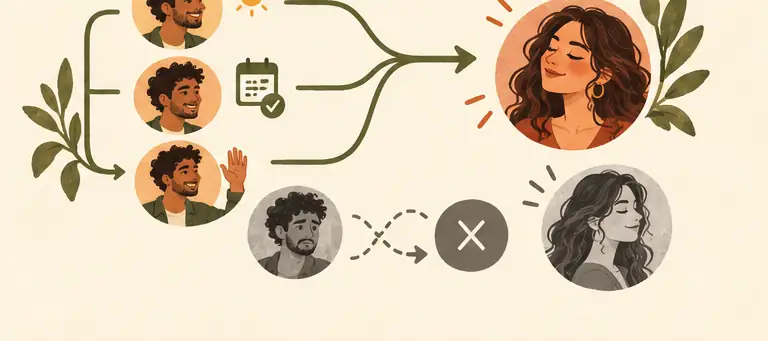
Do not use response timing as a game
Waiting a particular number of minutes to appear unavailable does not create honest clarity. People have different schedules and notification habits, especially when first meeting someone. Send a reply when it works for you, and be direct if you are not available or do not want to continue.
A delayed response can still be followed by a thoughtful answer; a fast response can still avoid a plan. The reply-time analysis guide explains how to read timing in context rather than using a stopwatch.
Keep expectations proportionate to an early chat
An early conversation is a small sample, not a full account of a person’s communication style. Someone may be cautious with a stranger, busy, or unsure what topic to pick. You can stay curious without investing more time than you want. If you prefer fuller conversation before meeting, state that preference; if you prefer a short chat and a public meeting, say so plainly.
A better next step is not always another message. Sometimes it is a clear invitation, sometimes a respectful ending, and sometimes waiting to see whether the other person follows through. Keep your own boundaries and choices in view.
Frequently asked questions
What does dry texting on dating apps mean?
It usually describes replies that feel brief or difficult to continue. The phrase does not explain why someone wrote that way or prove whether they are interested.
What should I say to a dry texter on a dating app?
Ask one specific, low-pressure question or make a clear invitation if the conversation is ready. Then allow the other person to decide whether to continue.
Should I keep messaging if the replies are short?
You can try one relevant follow-up. If the conversation remains one-sided, you are free to stop without deciding what the other person intended.
Does a fast reply mean someone is interested?
Not necessarily. Response speed is affected by schedules and habits and does not prove private feelings. Consider reciprocity and follow-through as well.
Is a short reply a red flag when dating?
A short reply alone is not a red flag. Respect for boundaries, honesty, and safety matter more than message length.
How do I end an early chat politely?
Use a brief, clear message that says you do not want to continue. You do not need to debate or provide personal details.