Reply-Time Analysis: How Long to Reply to a Text?
There is no universal number of minutes that makes a reply interested or uninterested. Reply-time analysis is more useful when it compares a person’s typical rhythm with a sustained change, while accounting for schedules, time zones, and whether the conversation moves forward.
Try the free previewUpdated
What reply time can show
A timestamp can show the elapsed time between a message and a reply in an exported conversation. It can help describe a rhythm: a person often answers during lunch, returns to messages after work, or has recently begun replying at different times. It cannot show why someone waited or whether they saw a notification.
A WhatsApp chat analyzer may organize timing changes alongside message excerpts. The report still sees only the file you provide. Calls, another messaging channel, muted notifications, or offline conversations may explain part of the gap without appearing in the transcript.

There is no universal time limit
A reply in five minutes is not inherently more caring than a reply in five hours. People work, study, sleep, drive, care for others, or prefer to answer when they can focus. The meaning of a gap also depends on the message: a quick acknowledgement may suit a plan, while a sensitive question can reasonably need more time.
Avoid rules like “if they cared, they would answer immediately.” They turn a convenient number into a claim about motive. If a response time affects a practical plan, ask for a clear deadline. If it affects how connected you feel, explain that experience rather than demanding constant availability.
Compare the person with their own baseline
Timing is easier to interpret when you compare similar situations. Look at the same person, similar hours, and broadly similar types of messages. A person who answers logistical questions during the day may take longer to respond to a personal topic. A change from their own routine can be worth noticing, but still needs context.
A median interval can describe the middle of the observed reply times and is less affected by a single very long gap than a mean. Neither statistic says whether the exchange felt respectful. A small sample, missing timestamps, or a conversation dominated by group coordination can make any summary unstable.
| Signal | What it describes | What to check |
|---|---|---|
| Typical interval | The usual gap in the messages included. | Sample size, time zone, and missing replies. |
| Change from baseline | Whether the recent rhythm differs from an earlier period. | Whether the periods are comparable. |
| Time-of-day pattern | When replies tend to arrive. | Work, sleep, care duties, and notification access. |
| Follow-through after a delay | Whether the person returns to the question or plan. | What they actually said and did next. |

Time zones, work, and everyday routines
If participants live in different time zones, a timestamp may be displayed in the device’s local time or converted by the export. Confirm that the file represents the same clock consistently before comparing hours. Nighttime messages can also be delayed until morning because someone is asleep, not because they chose a symbolic response interval.
Shift work, meetings, classes, caregiving, battery limits, and notification settings can affect timing. These possibilities do not need to be guessed in advance. If a delay matters, ask about availability in concrete terms: “What is a good time to reach you?” or “Could you let me know by noon if the plan changes?”
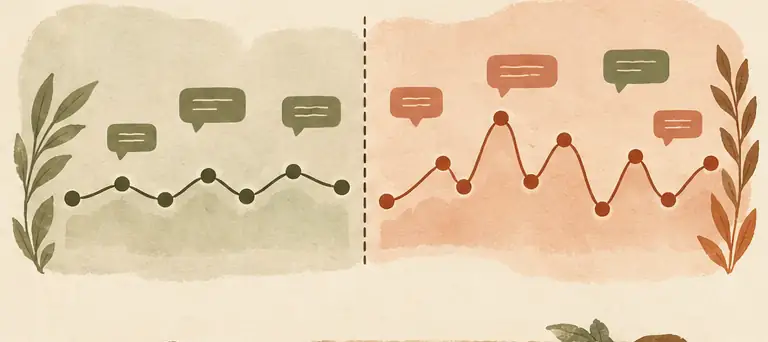
Fictional example: a longer gap with a clear follow-up
Fictional example: Jordan replies to a lunch invitation six hours later: “Sorry, I was in training. I can meet Sunday at one if that works.” The gap is longer than the previous exchange, but the answer explains availability and proposes an alternative. The timeline alone would miss that practical follow-through.
Another fictional example: a reply arrives quickly but repeatedly avoids confirming a date. Speed and clarity are different signals. Reading the words, timing, and next action together gives a more useful description than ranking people by average minutes.

When a change is worth discussing
A sustained change may matter when it leaves plans unresolved, interrupts an agreed routine, or makes it hard for you to know whether to wait. State the practical impact: “When I do not hear back about the reservation, I cannot plan the evening. Can we agree to confirm by four?” This creates a clear request without claiming to know why the replies slowed down.
If the person cannot meet the request, you can decide how to plan around that. You do not need to keep checking a read receipt or sending tests. The dry texter or not interested guide discusses wider participation, and who texts first covers initiation separately from timing.
Limits of reply-time analysis
A reply-time chart depends on the messages and timestamps available. It may not capture when the person saw a message, whether they were free to respond, or whether the chat continues somewhere else. Export formatting, daylight saving changes, and mixed time zones can also affect calculations. A chart is a prompt to verify, not a verdict.
DryText reports can summarize reply patterns in supported exports and link observations to text excerpts. They cannot identify private intent from response speed. Read how DryText works, the WhatsApp export guide, and privacy information before uploading.

Choose a reply expectation that works for both people
Healthy communication does not require instant replies. It can help to agree on a simple norm for time-sensitive plans while letting ordinary messages wait. If you need an answer by a certain time, say when and why. If someone needs space to respond, discuss a signal that feels comfortable to both of you.
A timing difference may be manageable, or it may not fit what you need. Decide based on the repeated interaction and clear conversations, not a universal timer. The point of analysis is to make the observed pattern understandable enough to discuss.
Frequently asked questions
How long is too long to reply to a text?
There is no universal limit. The right timing depends on the topic, schedules, expectations, and the person’s usual communication pattern.
Does a slow reply mean someone is not interested?
No. A delay can have many causes and cannot reveal private intent on its own. Look at the wider pattern and ask directly if timing affects a plan or your needs.
How do I analyze WhatsApp reply time?
Use a representative export with consistent timestamps, compare similar periods, and check the messages around each delay. Remember that an export may omit other channels and offline context.
Is median reply time better than average?
A median is less affected by one unusually long gap and can describe a typical interval more robustly. Neither statistic explains why someone replied when they did.
Should I reply slowly to match someone?
Deliberately delaying as a test usually adds ambiguity. State your own availability and expectations clearly instead.
Can a chat analyzer tell when someone saw my message?
A standard exported transcript may show message timestamps, but it does not reliably establish when someone noticed or read every message.