Who Texts First? Read Initiation Without Keeping Score
Who texts first can show who opens conversations in a particular sample, but it cannot prove who cares more. Separate starting a thread from replying, continuing a topic, and making plans, then compare those behaviors over time and across real-life context.
Try the free previewUpdated
What “who texts first” actually measures
In a message history, “who texts first” usually means who sends the first message after a conversation has naturally paused. The result depends on how a chat is divided into threads. A “good morning” after sleep may begin a new exchange; a reply to last night’s question may be a continuation. Define the window consistently before counting.
Initiation is one observable behavior. It is not the same as message volume, warmth, responsiveness, or interest. The dry text meaning guide explains why a single messaging signal cannot explain what someone feels.
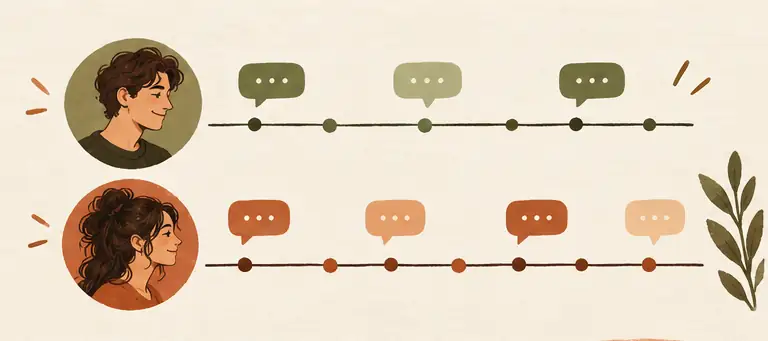
Separate starting from responding
One person may begin more chats while the other contributes longer replies, makes plans, or follows up later. Those roles do not cancel each other out. If you count only first messages, you miss the quality and practical outcome of the exchange. If you count every line, a person who sends several short messages can appear more active than someone who writes one detailed answer.
A fair review separates at least four questions: who starts after a pause, who responds, who asks or answers follow-up questions, and who turns a conversation into a plan. A WhatsApp chat analyzer can organize initiation patterns in a supported export, but you should check any conclusion against the excerpt and your knowledge of the participants.

The time window changes the count
There is no universal pause that turns a continuation into a new conversation. A few hours might be a long gap in an active planning thread and a normal gap in a casual exchange. Choose a window that fits the chat’s pace and apply it consistently. When possible, compare a typical period rather than a weekend or stressful deadline in isolation.
Message exports may omit calls, reactions, voice notes, or interactions in another channel. They may also have time-zone or timestamp formatting differences. A raw count should say what period and data it uses; without that information, “who always texts first” is stronger than the evidence supports.
| Signal | Useful question | Common blind spot |
|---|---|---|
| First message after a pause | Who reopened the chat in this period? | A pause may not mean the conversation ended. |
| Follow-up after a reply | Who added a new question or detail? | Some complete answers need no follow-up. |
| Plan initiation | Who suggested a time or activity? | Plans can be made offline or in another channel. |
| Response after a delay | Did the person return to the topic? | A delay alone does not show interest or avoidance. |
Consider routines and circumstances
Work shifts, school schedules, time zones, caregiving, notifications, and preferred communication habits can influence who sends the first message. A person who starts fewer conversations may still respond thoughtfully when available. Someone who sends “hey” every morning may initiate often without contributing much after the greeting.
Context is not an excuse you need to invent for someone. It is a reason to keep a count descriptive rather than moral. If the imbalance matters to you, explain what you want: more shared planning, a check-in when someone is busy, or clarity about whether you both want to keep talking.

Fictional example: the first text is not the whole exchange
Fictional example: Alex usually sends the first message after work, while Riley answers later with a detailed question and suggests a time to meet. Counting only the opening text makes Alex look like the sole participant. Counting only the plans would miss that Alex consistently reopens the conversation. Both observations can be true.
Fictional example: Riley sends “Are we still meeting?” after Alex has not answered a time question. That message begins a new thread in the export, but it is also a follow-up to unresolved planning. A reliable description keeps the sequence visible instead of turning one field in a table into a relationship verdict.
Discuss reciprocity instead of keeping score
A count is most useful when it helps you name an experience: “I notice I have started most of our recent conversations, and I would like to know if you want to keep making time for this.” That is clearer than “You never text first.” The latter invites an argument over exceptions, while the first explains what you need.
If both people want more contact, agree on something practical. If one person wants less, a direct answer may be disappointing but more useful than silently tracking every message. The guide dry texter or not interested? offers ways to separate texting style from a broader change in participation.

How a report can organize initiation patterns
A chat report can summarize who appears to start conversations in the supplied export, highlight shifts across the included period, and connect an observation to message excerpts. It cannot see conversations outside the file, know which person had more free time, or determine how either participant feels. A missing conversation can change the apparent balance.
Read the source messages around each finding and confirm that the report identifies participants correctly. For WhatsApp, see the export instructions. Before uploading, review how DryText works and the privacy and retention page.
Use the pattern to ask a useful question
Instead of asking who should text first, ask what kind of contact works for both of you. “I like when we both initiate plans. Would you be open to alternating who picks the next activity?” is a concrete request. The other person can agree, suggest another way, or tell you that their preferred level of contact is different.
You do not have to wait for a dataset to decide whether an arrangement feels good. Use counts to notice a pattern, verify it, then make a choice based on your needs and the person’s response. A statistic is a description of a sample, not a verdict about care.

Frequently asked questions
What does it mean if I always text first?
It means you appear to start more conversations in the period you are thinking about. It does not by itself explain why, or prove how either person feels.
Should both people text first equally?
There is no required split. Different schedules and communication preferences can create different patterns. Discuss whether the current level of reciprocity works for both of you.
Does texting first mean someone is more interested?
Not necessarily. Initiation is one behavior among many. Follow-through, responsiveness, plans, and offline context also matter.
How do you count who starts a conversation?
Choose a consistent pause that fits the chat, then distinguish a new conversation from a follow-up to an unresolved question. State the time period and data used.
Can WhatsApp reply-time analysis show who cares more?
No. An export can show timestamps and message patterns, but not private feelings, schedules, or all communication outside the file.
Can DryText tell who starts conversations?
A report can summarize initiation patterns in a supported export and link observations to excerpts. It cannot see missing messages or infer intent.